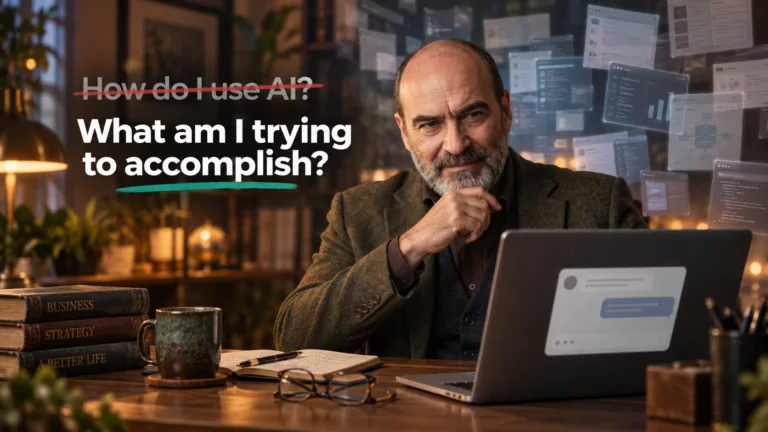


AI tools provide instant tactical answers, but they cannot identify whether a blogger is solving the right strategic problem — that judgment still belongs to the human.
Most baby boomers come to niche blogging with real-world experience, professional expertise, and a genuine desire to help people. The problem is not a lack of effort or work ethic. The problem is that artificial intelligence makes it dangerously easy to get incredibly detailed, highly accurate answers to the wrong questions, faster than ever before.
If you are building a business to secure your retirement, you cannot afford to waste months chasing the wrong goals.
Problems This Post Will Solve:
- Why your blog is not getting traction even when you are following AI advice to the letter.
- Why “more content” and “more traffic” are often the wrong goals for a new niche site.
- How to use AI as a strategic thinking partner rather than just a content production machine.
What You Will Understand After Reading:
- The critical difference between a surface-level problem and the foundational problem hiding underneath it.
- Why a 300-year-old mathematical breakthrough is the most practical blogging lesson you will read this year.
- How to reframe your niche questions to get high-value, highly profitable outputs from AI.
For those looking for a comprehensive, structured environment to build their niche business and put these strategies into practice, I highly recommend checking out Wealthy Affiliate. It remains the premier platform for learning how to build a real, sustainable online business from scratch.
Keep reading — the mathematical concept in the next section takes less than a minute to understand, but it will permanently change how you approach every blogging obstacle you face.
The Question That Sounds Right But Isn’t
When a blogger asks “How do I get more traffic?” they are asking a tactical question. But traffic is an outcome, not a foundation. If the niche is unclear or the reader is undefined, more traffic only amplifies the existing problem.
Imagine a new blogger sitting down at their desk, opening an AI tool, and asking a seemingly logical question: “How do I get more traffic to my blog?”
Within seconds, the AI spits out a perfectly accurate list of tactics:
- Write better headlines.
- Use targeted keywords.
- Post consistently.
- Build internal links.
- Share on social media platforms.
- Improve your page load speed.
None of this advice is incorrect. In fact, it is exactly what search engine optimization professionals recommend. The blogger spends weeks diligently implementing every single bullet point. They write more, share more, and optimize more.
Yet, the needle barely moves. The traffic stays flat, or worse, a few random visitors arrive but leave immediately without reading or clicking anything.
What went wrong?
The blogger asked for better answers, but they were asking from the wrong version of the problem. If your niche is too vague, if your reader is unclear, or if you are writing about a topic you like rather than an urgent problem your reader desperately wants solved, then traffic is not your issue.
This is the core of the KIPID framework: Knowledge is Power is Dead.
In the age of AI, access to tactical knowledge is no longer a competitive advantage. Anyone can generate a list of SEO tactics in three seconds. The real advantage belongs to the blogger who knows exactly who they serve, what those readers need, and how to communicate a clear solution.
A 300-Year-Old Math Lesson That Every Blogger Should Know
The mathematical identity known as the Sophomore’s Dream, first discovered by Johann Bernoulli in 1697, demonstrates that rewriting a problem into a better form — rather than forcing a solution on the original form — is often the most powerful move available.
Do not worry; this is not a calculus class, and you do not need to solve any equations. But the thinking move behind it is beautiful.
In its raw form, the expression looks ugly:
At first glance, this is an awkward, ugly mathematical expression to work with. The base is x, and the exponent is also x. Both parts are moving variables at the same time. Trying to integrate or differentiate this directly is incredibly difficult.
But mathematicians do not panic when they see an ugly problem. Instead, they apply a clever rewrite using basic algebraic identities:
In plain terms: x raised to the power of x is mathematically identical to the constant e raised to the power of x times the natural logarithm of x.
The original problem did not vanish. Nobody cheated. Nobody skipped the hard work. But by rewriting the expression into a different form, mathematicians transformed an intractable problem into a standard, workable calculus problem. They changed the form of the problem so it could be solved.
This is the exact thinking move that struggling niche bloggers must learn. Most bloggers spend months trying to force a solution to an “ugly” version of a problem, when they should be pausing to rewrite the problem itself into a workable form.
The Boomer Blogger
The Three Questions Bloggers Ask Wrong
Three of the most common questions new bloggers ask — about traffic, posting frequency, and AI speed — are all surface-level restatements of a deeper strategic problem: the absence of a clearly defined reader and a clearly defined problem to solve.
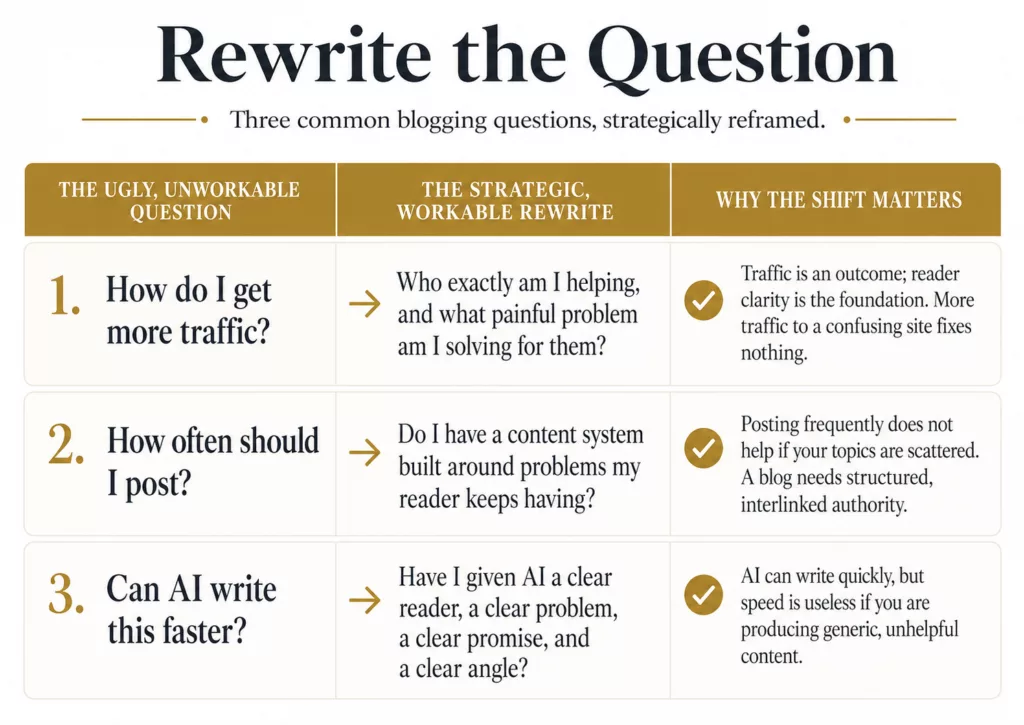
Let us look at how this mathematical “rewrite” applies directly to the everyday challenges of building a niche website. Struggling bloggers almost always ask the wrong version of the question, leading them to apply high effort to low-leverage tasks.
When you ask, “How often should I post?” you are focusing on a calendar. But when you rewrite it to focus on a content system, you begin to build topical authority. You stop writing random articles and start building a structured web of content where every post naturally links to the next, guiding the reader step-by-step through their journey.
Likewise, asking “Can AI write this faster?” is a factory-worker mindset. AI can write a 1,000-word article in thirty seconds, but if that article contains no unique perspective, no deep empathy for the reader, and no specific angle, it is just noise. The real question is whether you have done the strategic thinking required to give the AI something worth writing about.
How AI Rewards Better Thinking — and Exposes Weak Thinking
AI does not remove the need for strategic thinking. It accelerates the consequences of weak thinking. A blogger who uses AI without a clear niche strategy will produce more content faster — but in the wrong direction.
A common myth in the blogging world is that AI is a shortcut that replaces the need to think. In reality, AI does the exact opposite: it exposes weak thinking faster than ever before.
A weak blogger uses AI to mass-produce generic articles before their strategy is clear. They publish dozens of posts on broad topics, hoping something sticks.
A sophisticated blogger uses AI to pressure-test their assumptions. They use the tool to find gaps in their niche, identify common objections their readers might have, and sharpen their core message before they write a single word of a draft.
To see this difference in action, compare these two different prompts:
Prompt A (The Weak Thinker):
Write me a blog post about affiliate marketing.”
Prompt B (The Strategic Thinker):
“My reader is 61 years old, worried about retirement income, highly skeptical of online business, and easily overwhelmed by technology. Give me five article angles that explain affiliate marketing as a low-cost, low-risk income path without hype or technical jargon.”
The AI will generate text for both bloggers. But the output for Prompt A will be a boring, generic article that reads like a Wikipedia entry. The output for Prompt B will be highly targeted, empathetic, and genuinely useful to a specific human being.
The second blogger did not let the AI think. They did the hard work of defining the reader and the problem first. This is the exact philosophy behind SettingPoints.com and the Amazing Niche Master Workbook: Fix the Niche. Fix the Message.
Everything Changes. Once you clarify your core message, your AI tools become infinitely more powerful.
The Blogging Version of the Formula
Just as the mathematical rewrite xx→exlnx transforms an unwieldy expression into a workable one, bloggers can apply the same move to their strategy: rewriting vague, outcome-focused problems into specific, reader-centered ones.
If we were to write a mathematical formula for niche blogging success in the age of AI, it would look like this:
Let us look at how this formula transforms the most common roadblocks bloggers face:
- “I need more traffic” becomes “I need a specific reader with a specific, urgent problem.”
- “I need more content” becomes “I need a system that systematically answers the questions my audience keeps asking.”
- “My niche is not working” becomes “My niche may not be framed around a painful enough problem.”
- “AI is not helping me” becomes “I may be asking AI to produce content before I have clarified my strategy.”
Many new bloggers are in a desperate rush to publish. They want to see pages on their site, and they want to see them now. That is understandable. Publishing feels productive. It feels like progress.
But publishing faster is not the same as building a better business. If your underlying strategy is weak, publishing faster only helps you move in the wrong direction faster. You are simply building a larger monument to a mismatched niche.
A Simple Exercise Before Your Next Post
Before using AI to write a blog post, a blogger should spend five minutes answering seven diagnostic questions about the reader, the problem, and the angle. This short exercise consistently improves post quality more than any tactical optimization.
Before you sit down to write your next article or open your favorite AI writing assistant, pause for five minutes. Do not write a draft. Do not look up keywords.
Instead, answer these seven diagnostic questions:
- What visible, surface-level problem am I trying to solve?
- What deeper, emotional problem is hiding underneath it?
- Who exactly has this problem (age, situation, fears)?
- What have they already tried to solve it?
- Why did those previous attempts fail or fall short?
- What would make this post incredibly useful even if someone could get a basic answer from a search engine?
- Can I rewrite this topic into a sharper, more specific, and more useful form?
This short exercise will completely transform the quality of your content.
For example, instead of writing a generic, boring article titled “How to Start a Blog,” you might realize the real, rewritten topic is: “How to Start a Blog When You Are 60 and Cannot Afford Another Expensive Mistake.”
That rewritten title has a real person. It has real pain. It has an urgent reason to read. And when you feed that level of clarity into an AI tool, the resulting article will be outstanding.
FAQ Section
Can AI help me find the right niche for my blog?
Yes. AI can help you brainstorm niche ideas, test angles, compare audience problems, and identify possible content gaps. But AI should not make the final niche decision for you.
The right niche still depends on human judgment. You need to understand real-world problems, market demand, reader urgency, and where your experience can provide genuine value. Use AI to explore options, but use empathy and common sense to choose the problem worth solving.
Why is my blog not getting traffic even though I am following standard SEO advice?
Because SEO tactics only work after your content is built around a clear reader and a specific problem.
Keyword placement, page speed, internal links, and image optimization matter, but they cannot save vague content. If your niche is too broad or your articles sound generic, search engines have little reason to rank you and readers have little reason to stay.
Traffic is an outcome. Reader clarity comes first.
How do I know if I am asking AI the right questions when writing content?
You are asking better AI questions when your prompt includes four things:
A clear reader, a specific problem, a strong promise, and a unique angle.
A weak prompt sounds like:
“Write an article about gardening.”
A stronger prompt sounds like:
“Write an article for retired beginners who want to grow vegetables in containers because they have limited space, limited mobility, and no gardening experience.”
AI works better when your thinking is sharper before you write the prompt.
What is the Setting Points method and how does it help new bloggers?
The Setting Points method helps new bloggers clarify their niche, message, reader, and content direction before they waste months publishing scattered articles.
The principle is simple:
Fix the niche. Fix the message. Everything changes.
Instead of creating generic content for a vague audience, the method helps bloggers build around a specific reader with a specific problem. That is how a blog starts moving toward authority, trust, and long-term income potential.
You can find resources and step-by-step guidance, including the Amazing Niche Master Workbook, at SettingPoints.com.
The Strategic Path Forward
When you are trying to build a successful niche website, it is easy to get overwhelmed by the sheer volume of tasks. You might think that using AI for blogging is simply about generating articles as fast as possible to fill up your site. But this approach is why so many new blogs fail. They focus on volume instead of value.
If you want a successful niche blogging strategy, you have to stop asking how to write faster and start asking how to think clearer. The most valuable AI blogging tips do not involve complex prompt engineering or secret software settings; they involve basic human clarity. Before you write, you must know exactly who you are writing for and what specific, painful problem you are solving for them.
This is the ultimate lesson of the Sophomore’s Dream. When a problem looks too difficult, too competitive, or too frustrating, do not just push harder. Reframe it. Find the right problem instead of chasing the wrong question. By shifting your focus from generic traffic to specific reader empathy, you will build a blog that stands out, builds trust, and generates real income.
If you are ready to stop guessing and start building with a proven system, head over to SettingPoints.com and grab the Amazing Niche Master Workbook today. It is the exact tool you need to rewrite your blogging problems into profitable solutions.
Start before the platform.
Your niche isn’t on a list. It’s hidden in what you already know. The Amazing Niche Master finds your Starting Niche and tests it against the real market. You don’t need a niche idea. You need honest answers.