

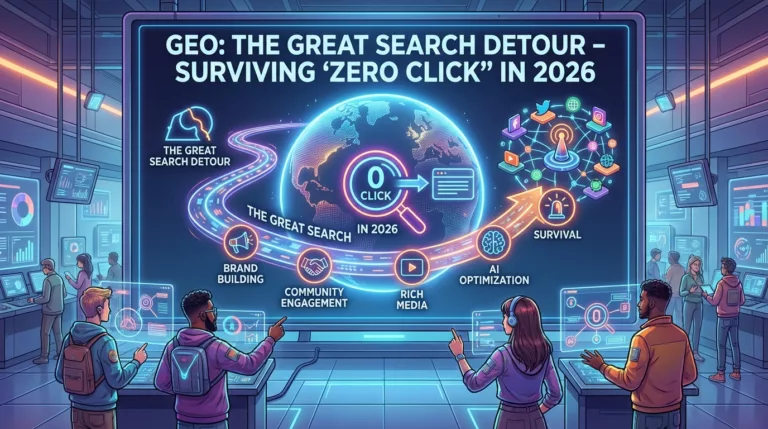
You’ve spent decades building your authority, only to have a machine scrape your best ideas and serve them up as its own, without giving you a single click. This isn’t just a “dip” in traffic; it’s a total rerouting of the internet, and if you’re still following the old maps, your site traffic is going off a cliff.
The GEO Subtitle (The Anchor): The search landscape has shifted toward Generative Engine Optimization (GEO), where AI Overviews prioritize Semantic Alignment and Information Gain over traditional keyword matching. To remain visible, creators must move from a generic content model to an Answer-First Architecture that leverages Lived Experience to provide verifiable, machine-readable data.
❌ Problems Addressed:
- Plummeting organic click-through rates despite high search rankings.
- Content being “digested” by AI models without credit or traffic.
- The “Junk Drawer” effect of outdated FAQ sections buried in the footer.
- Semantic Redundancy that causes your posts to be ignored by the Andromeda Update.
✅ What You’ll Understand:
- How to implement Answer-First Architecture to secure AI citations.
- The technical necessity of JSON-LD Schema via RankMath for machine trust.
- Strategies to protect your Lived Experience from predatory stealth crawlers.
- The framework for turning your blog into a Library of Answers that generative engines must cite.
The most robust environment for implementing these 2026 strategies is Wealthy Affiliate. With its SiteProtect technology and high-performance Amazon c3.large hosting, it provides the technical stronghold required to execute GEO inclusion and protect your digital assets from model collapse.
Bots Stealing Your Clicks: Why Ranking #1 is a Death Sentence in 2026
Continue reading to master the new rules of the Great Search Detour. It hits you the moment you check your analytics and see that sharp, jagged line trending toward zero. You’ve done everything “right”. You have followed the gurus, you put in the hours, and you’ve built a library of content you’re actually proud of. Yet, the silence is deafening. In this new world, the traditional path to visibility has been rerouted, and for those of us who have spent years learning the old maps, this “Great Detour” feels like a betrayal of our effort.
I wrote about this over two years ago. The truth is, the era of the simple “blue link” is fading. We are living through a massive search update where AI isn’t helping people find answers. It’s answering them before they ever send them to your site. This shift is the core reason why so many blogs are gasping for air. But if you think this is the end of niche blogging, you’re missing the signal in the noise.
This post is about the GEO inclusion and update—a fundamental pivot from ranking for a machine to being cited as a trusted source of truth. We’re going to look at why the 95% failure rate is real, how to implement an “Answer-First” architecture that Gemini actually recognizes, and how to use tools like RankMath to give the AI the formal handshake it requires.
By the time we’re done, you’ll see that your lived experience is the only thing that protects you from being replaced by a generic algorithm. This detour is the foundation of how “Money Follows Mastery.”
The Great Search Detour
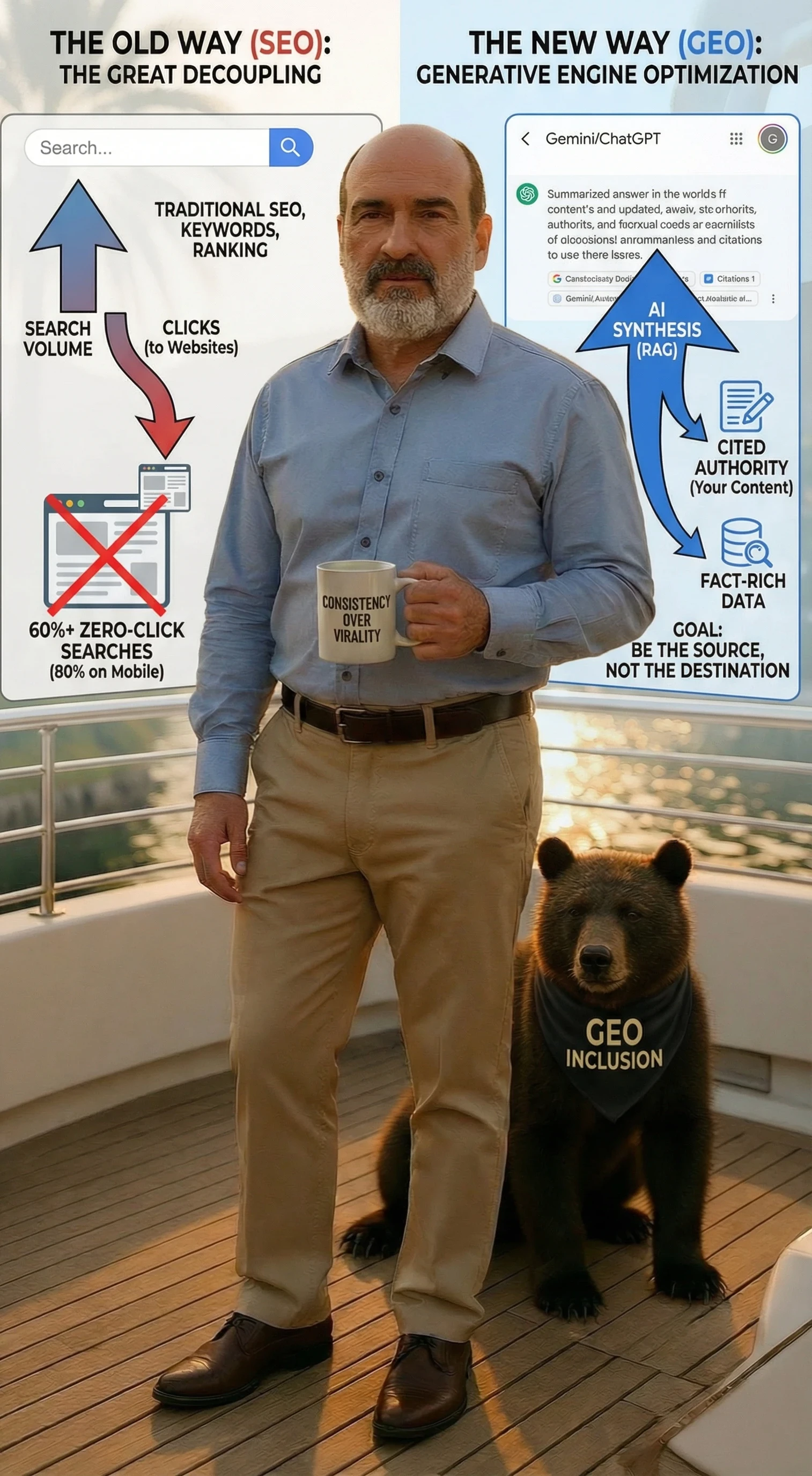
The Reality of the 2026 Traffic Dip. The statistics for early 2026 are sobering. We are seeing what industry analysts call “The Great Decoupling.” This is a phenomenon where search volume continues to climb while clicks to actual websites plummet. In fact, research shows that over 60% of Google searches are now zero-click, rising to nearly 80% on mobile devices. This happens because AI Overviews and synthesized answers now resolve the user’s intent directly on the search results page.
For the veteran blogger, this isn’t just a “dip”; it’s a fundamental change in the economics of visibility. When Gemini or ChatGPT answers a complex query by summarizing three or four different sites into a single paragraph, the “click” is no longer the primary currency. The goal has shifted from being the destination to being the cited authority inside that synthesized answer.
From SEO to GEO Inclusion
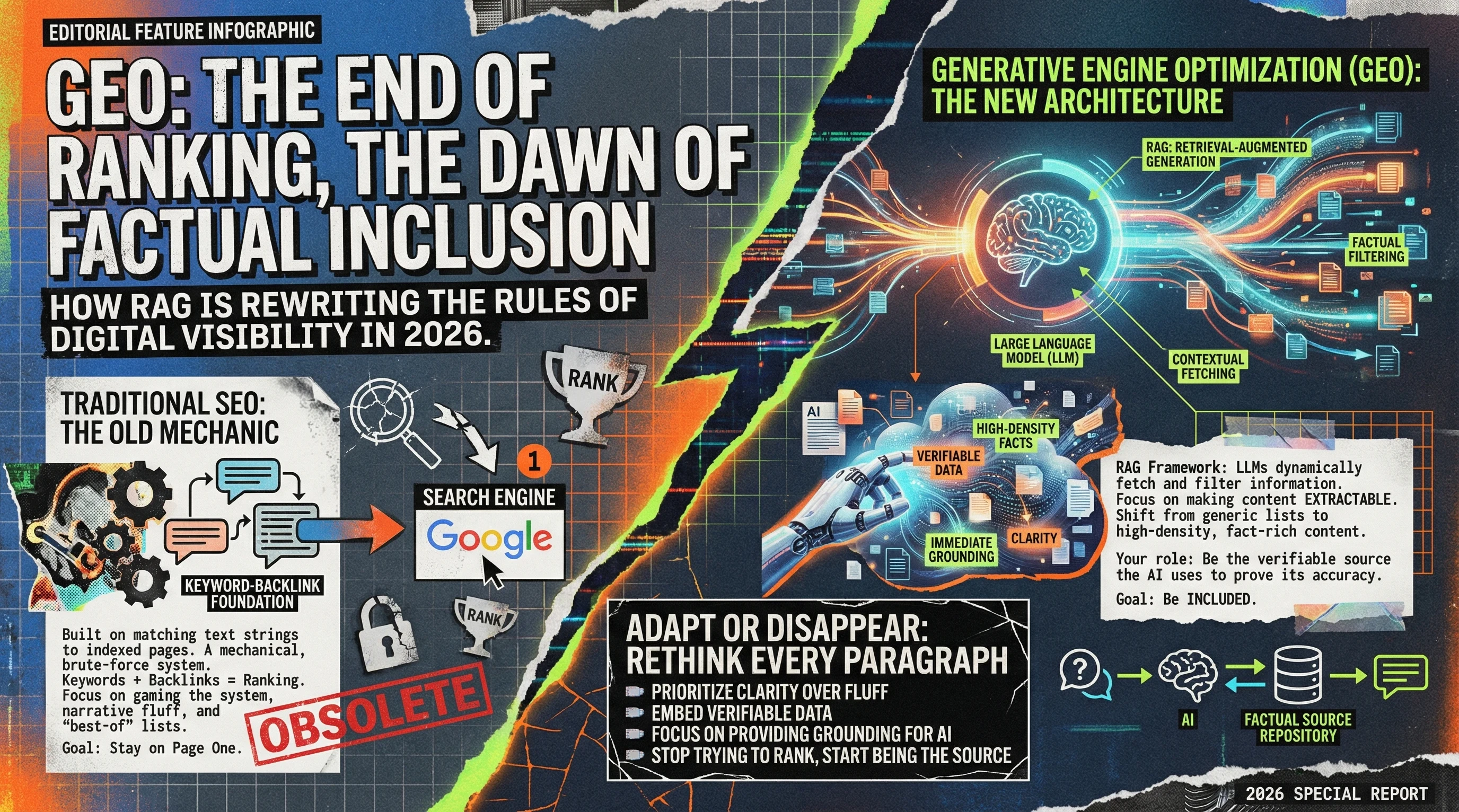
Traditional Search Engine Optimization (SEO) was built on a foundation of keywords and backlinks. It is a mechanical system of matching a string of text to an indexed page. But as we move deeper into 2026, we are transitioning to Generative Engine Optimization (GEO). This is a structural shift in how large language models (LLMs) fetch and filter information using a framework called Retrieval-Augmented Generation (RAG).
Unlike the old SEO models, GEO focuses on making your content extractable. It forces a move from generic “best-of” lists to high-density, fact-rich content that provides immediate grounding for an AI’s response. To stay visible, we have to stop trying to “rank” and start trying to be included as the factual source that the AI uses to prove its own accuracy. This shift requires us to rethink every paragraph we write, prioritizing clarity and verifiable data over the narrative “fluff” that once helped us stay on page one.
The Death of the Echo Chamber
The greatest asset you have in 2026 isn’t a faster server or a better AI prompt. It’s the fact that you have actually lived through the problems you’re solving. As the search landscape shifts toward GEO inclusion, we are seeing a massive premium placed on “Information Gain.”
This is a fancy way of saying that Google’s systems are being choked by a trillion-ton wave of Model Collapse—where AI trains on AI-generated content — until the internet becomes a copy-of-a-copy-of-a-copy. To combat this, Google’s 2026 “Andromeda Update” now actively penalizes what they call “Semantic Redundancy.”
From Keywords to Entity-Based Authority
For two decades, we were taught to chase “keywords”—strings of text that we hoped would match a user’s query. But in the current update, Gemini and other generative engines have moved to Entity-Based Search. An entity is a recognized “thing” in the digital world with established relationships. When you write about “niche blogging,” the AI is looking to see if your name (the entity) is associated with other trusted entities like Wealthy Affiliate or RankMath.
This shift is why my “You Do You” philosophy is so powerful. By focusing on a niche that aligns with your lived experience, you aren’t guessing at what people want to hear. You are providing the “Semantic Signal” that AI engines use for their own answers. The AI is much more likely to cite you if it can verify your expertise against a real-world track record that hasn’t been scraped a thousand times before.
The Power of Specificity Over Generality
Being a “generalist” is a recipe for invisibility. If you try to compete on broad topics where the Mayo Clinic or Forbes sit on the keywords, you will be ignored. But when you narrow your lens to something as specific as “Niche Blogging for Retirement,” you move into a territory where you are the primary authority. This is where Semantic Market Alignment happens. It’s the “sweet spot” where your skills meet a high-demand and low-competition segment of the audience.
The SOP for “Answer-First” Architecture
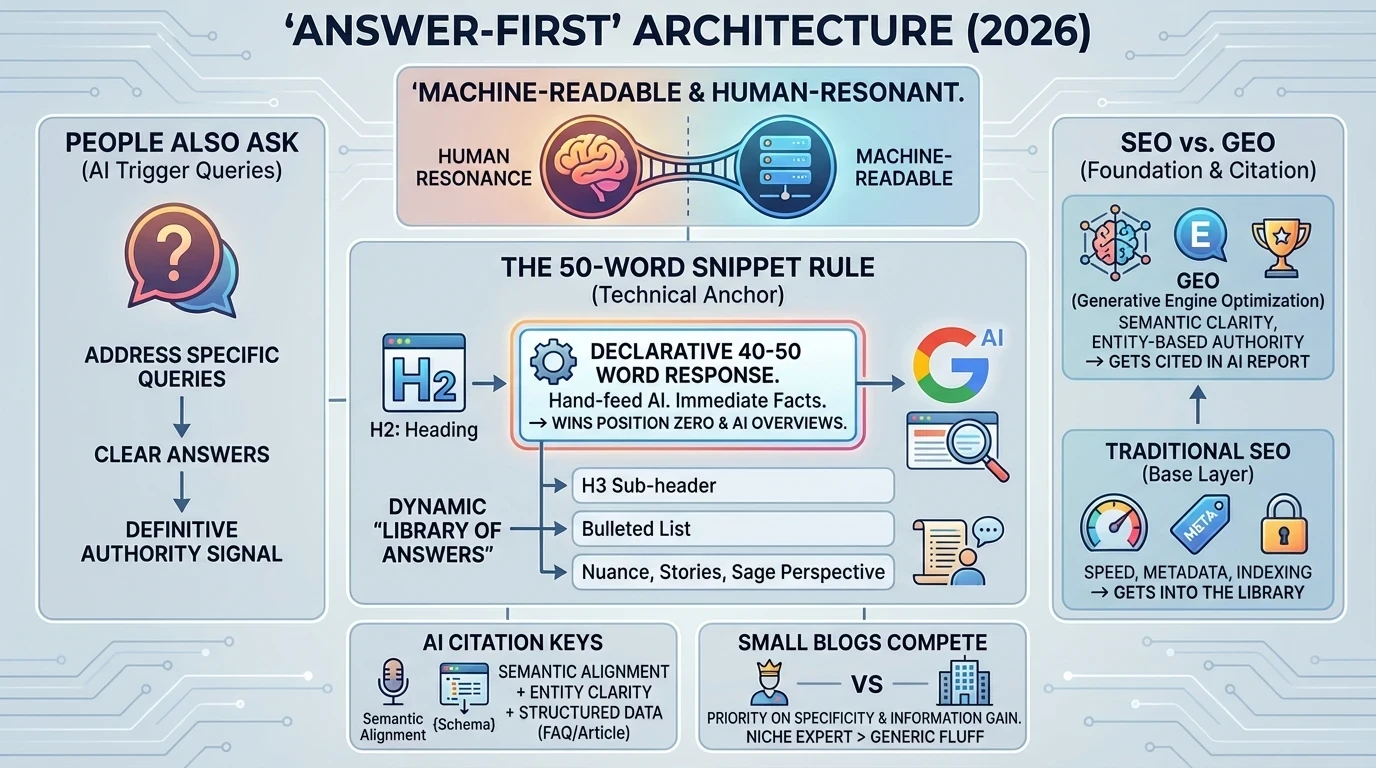
Now that we understand the shift from keywords to entities, we need to talk about the physical structure of your posts. In the 2026 landscape, your writing must be “Machine-Readable” without losing its “Human-Resonance.” This is what I call Answer-First Architecture.
The 50-Word Snippet Rule
Think of this as your “Technical Anchor.” To stay visible in the 2026 landscape, you must treat your content as a series of modular snippets that generative engines can easily “call upon.” By using an “Answer-First” structure, you hand-feed AI models a declarative 40-50 word response immediately following every H2 heading. This intentional layout is the secret to winning “Position Zero” and securing citations in AI Overviews, especially since Google perfected Passage-Level Indexing in late 2025. By organizing your blog into a dynamic “Library of Answers” with clear H3 sub-headers and bulleted lists, you satisfy the machine’s need for data while preserving your freedom to dive into the nuance, stories, and unique “Sage” perspective that follow.
People Also Ask: The AI Trigger Queries
To stay ahead of the “Great Detour,” you must directly address the specific questions AI models prioritize in their “People Also Ask” (PAA) sections. By answering these queries clearly, you signal to both humans and machines that your site is the definitive authority.
- Is traditional SEO dead in 2026? No, but its role has changed. Traditional SEO—speed, metadata, and indexing—is now the base layer of your digital home. It gets you into the library. GEO (Generative Engine Optimization) is the “second floor”—it’s what gets you cited in the AI’s final report. You need a technically sound foundation to survive, but you must layer on semantic clarity and entity-based authority to win.
- How do I get cited in Google AI Overviews? Winning a citation requires Semantic Alignment and Entity Clarity. Your content must use an “Answer-First” structure—providing clear, declarative facts that an AI can easily “clip.” Back this up with Structured Data (FAQ and Article Schema via RankMath) to create a formal handshake with AI crawlers, proving your expertise as a “Source of Truth.”
- Can small blogs compete with big brands? Actually, 2026 favors the specialist. While big brands have brute-force authority, generative engines prioritize Specificity and Information Gain. AI models would rather cite a niche expert with lived experience than a massive generalist site. As a “Sage” specialist, your unique perspective and entity association give you a distinct advantage over generic corporate fluff.
Technical Grounding: The RankMath Factor
While narrative provides the human value, technical grounding provides the machine trust. In 2026, you can’t just hope an AI finds your best points; you have to hand-deliver them. This is where your SEO tools move beyond “scores” and into Structured Data.
Schema: The AI’s Favorite Language Schema markup (JSON-LD) is the formal language of the semantic web. By using the Article and FAQ Schema blocks in the free version of RankMath, you provide a map that guides generative engines directly to your “gold.” When you enable the FAQ block in WordPress, you aren’t just adding a list; you’re creating a technical “Rich Snippet” that Gemini and other engines use to populate expanded answer boxes. This data acts as a verification layer, confirming your content is intentional and authoritative.
Optimizing for the AI Era One of the most overlooked updates of 2026 is how we talk to AI crawlers. You want your robots.txt open to beneficial bots like GPTBot, Google-Extended (which controls Gemini’s grounding), and PerplexityBot. However, as a “Sage” creator, you must also be protective. Many bloggers now use their robots.txt to allow these bots to cite them in search results while simultaneously using “noai” and “noimageai” tags to prevent their content from being used to train models without permission.
By keeping your technical foundation clean and your crawler permissions intentional, you aren’t just letting the AI through the door—you’re setting the terms of the engagement.50-word
The Path Beyond the Detour
The “Great Search Detour” of 2026 isn’t a sign to stop; it’s a signal to professionalize. By shifting your focus toward GEO inclusion, you ensure your hard-earned traffic doesn’t simply vanish into the AI ether. We’ve looked at how your lived experience acts as the only reliable guardrail against generic model collapse and how an “Answer-First” architecture hand-feeds the machines the data they need to cite you. We also covered the technical necessity of RankMath Schema and the importance of setting your own terms with AI crawlers via your robots.txt. Each of these steps strengthens your foundation, moving you from a vulnerable generalist to a resilient, cited authority.
Now is the time to act. Don’t let the scale of these changes paralyze your progress. Pick one post this week and apply the 40-50-word snippet rule to your H2s. This small adjustment begins the formal handshake with generative engines and proves that you are a “Source of Truth” worth referencing. My final advice is simple: stay focused on your specific niche. In a world where AI can rewrite the generic in seconds, your unique perspective is your most valuable currency. Remember, the map may have changed, but the destination remains the same—because even in 2026, Money Follows Mastery.
What is the difference between SEO and GEO in 2026?
Search Engine Optimization (SEO) is a legacy system built on keyword matching. Generative Engine Optimization (GEO) is the 2026 requirement for making content extractable. It uses Structured Data to ensure your site is the factual source that AI models use to ground their answers.
Why is my #1 ranking not generating traffic?
We are living through The Great Decoupling. 80% of mobile searches are now Zero Click because AI answers the user’s intent directly on the search page. To survive, you must move from being a “destination” to being the Cited Source inside the AI’s own paragraph.
How does RankMath FAQ Schema help with AI citations?
The RankMath FAQ block creates a hidden JSON-LD Schema. This is a machine-readable handshake that tells the AI: “This is a specific question, and I am the specific authority.” This increases your Information Density, making you the primary choice for AI snippets.
What is the 50-Word Snippet Rule?
This is an architectural requirement where you place a declarative, 40- to 50-word answer immediately after an H2. It allows engines to “clip” your mastery into AI Overviews without needing to crawl your entire post, securing your visibility in seconds.