


Use AI for the chores. You make the decisions. Let it sort your notes, rough out an outline, and clean up sentences you already wrote. Don’t let it pick your topic, tell you what to believe, or publish anything you haven’t read. If your routine falls apart in one bad week, it won’t last. If it does your thinking for you, it’s no longer your blog.
Forty Years of Experience. And Now I’m Supposed to Learn Another Damn System?
I get it. You have spent a long time getting good at something. You know how a job can go wrong before it actually does. You can spot a bad deal from the way the other person phrases a question. People continue to ask you for your opinion because it is worth having. That is a trust that you have earned. It is worth something if you can figure out how to make money online.
So, you look at online income and are hit with a new vocabulary: funnels, algorithms, prompts, stacks, agents, and AI. Each one comes with a course and a cost. Each course also assumes you are starting from zero. If you never leaned into You Do You, then yes, you are starting at zero. The experience was never yours to use. But if you did lean into it, the way I keep telling you to, this treatment should irritate you. Nobody enjoys being treated as a beginner in a room where they are the most experienced person.
Here is your first challenge. That irritation is useful information, because it points to something true. Your experience is the scarce resource in this whole arrangement. The systems that are being sold were designed without any regard for that. A blog built on what you know has an advantage that no system can emulate.
The question is how do you protect your position while you learn just enough of the technology to be useful. There is the hard way, and then there is the easy way. AI is at the heart of both answers.
The Problem Was Never a Lack of Tools
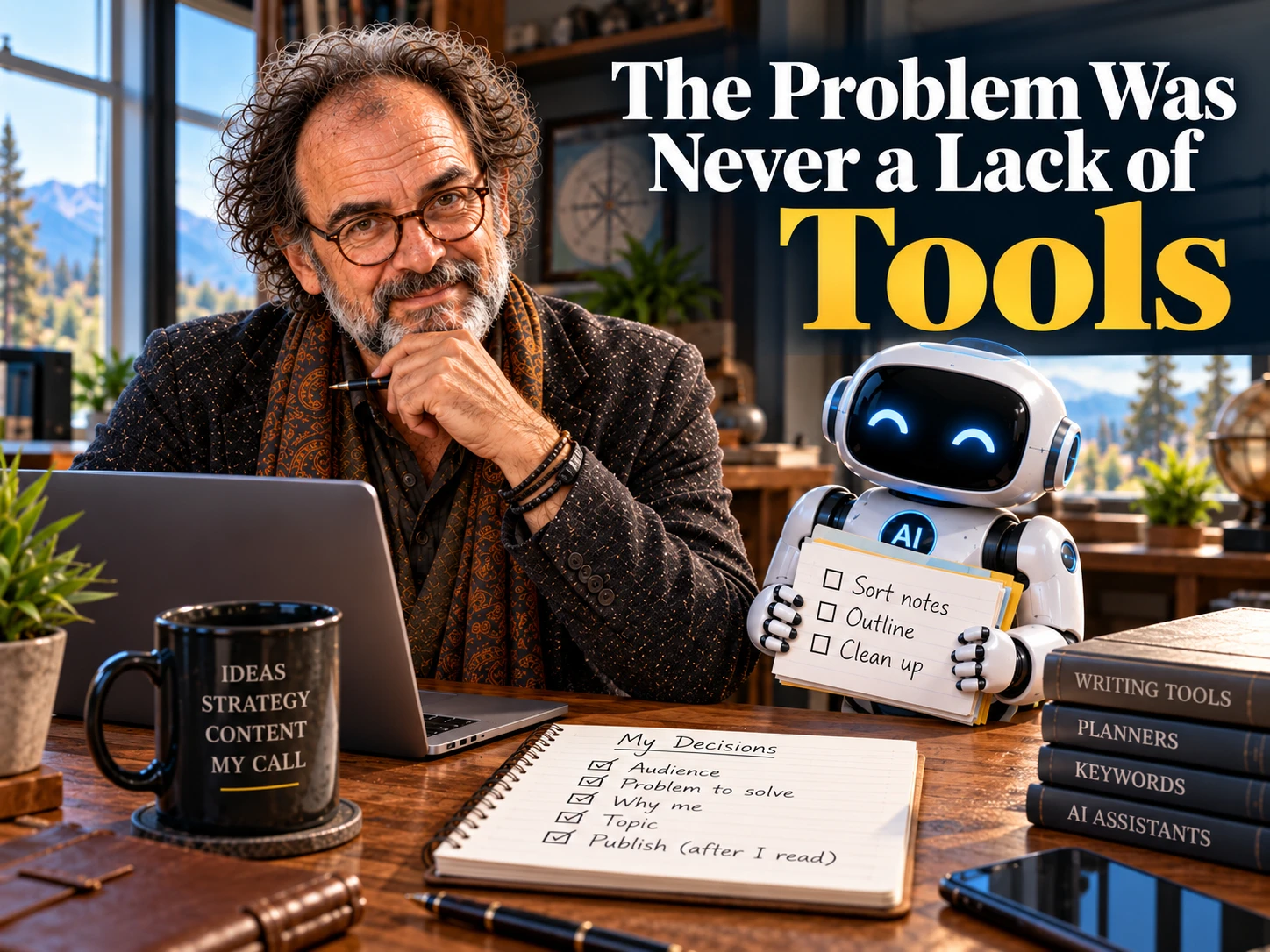
There are more writing tools, planners, keyword programs, and AI assistants available today than anyone could try in a lifetime. I use five chatbots consistently, have 3 agents running my research, and one posting to the socials consistently. If tools were the missing piece, blogs would not be failing at the rate they do. I have a whole article on why 95% of blogs fail, and the cause is rarely a missing piece of software.
What goes missing are the decisions that should have been made early on
- Who your blog is for
- What problem it helps people solve
- Why you are the person qualified to deliver the answer
A blogger without these answers can use the best tools available and still produce posts that read like everyone else’s. But a blogger with those answers can get by on a simple text editor and brain power.
Tools only speed up whatever direction you are already heading in. Point AI at a vague topic and you get vague posts, faster than ever.
That is why the first hour of a sustainable blogging workflow with AI has nothing to do with AI.
It goes back to the three simple questions above, and you answer these three questions on paper.
If you can’t answer that yet, no software will answer it for you.
See where I am going with this? You are publishing more posts than ever before. And yet, you are still going nowhere.
Stop Confusing Publishing with Progress
When a post goes live, it feels like progress. The date is stamped on, the count goes up, and your site looks busier. It is also the easiest thing to measure, which is exactly why people lean on it. I ask people to write one post a day for the first 30 days and have 60 posts in 90 days. There is a method to my madness. You should be able to talk my ear off about your niche without using notes. Your posts may not be the best ones out there; they do not need to be. You want people to find you and your way of thinking. Rough around the edges is okay. The repetition that you are putting in will hone your blogging skills.
But if you are using AI to create these posts, you are cheating yourself. AI doesn’t know what you know. AI can incorporate experience you provide; it cannot independently have lived that experience. Without it, your post will read just like every other blog in a niche that the person cannot relate to. This is the trap that AI has set for you. You have the entire year’s worth of posts ready at your fingertips. Who cares what they say? They are ready, and you are ahead of schedule. This is publishing.
Progress is different. When a reader who arrives with a specific problem finds what you wrote and sees that you understood their problem, they will trust you slightly more when they leave than when they came. They will remember that. One post written by you does more than twenty posts that sit unread and say nothing a reader couldn’t find elsewhere.
AI makes this lack of differentiation worse. AI removes the cost of producing words. Anyone can generate a month’s worth of posts in an afternoon. The output counter climbs higher while the blog’s actual standing with readers stays exactly where it was. Stored in the basement, filed under the category of “more of the same.” Creating more posts before you have answered the three questions only multiplies whatever flaws AI already had for you.
So here is a test to run on your own site.
Pick your five most recent posts and write one sentence for each describing the specific person it was written for and what they would do differently after reading it.
If you can’t write the sentence, then the post was published, but does not show progress. That is worth knowing, and it costs nothing to discover.
Put AI to Work. Don’t Put It in Charge
Think of AI the way you would think of a capable assistant who has never met you or your customers. It works quickly, it has read a great deal, and it has no idea what you have seen with your own eyes. It can answer questions confidently, even when it’s wrong. My arguments with AI are legendary. I have a file of AI responses where it put its apology in writing. Use AI. But never put them in charge of your blog!
This makes the division of labor clear. Jobs that suit AI

I covered the reasoning behind this split: AI can give you answers, but it cannot decide which problem you should solve. The short version is that an answer is cheap and a choice is expensive. You are the one with the experience to make the choice, so that part of the work never gets delegated.
What a Realistic Week of Blogging Looks Like
Nobody’s week is clean. Picture one that is typical for someone in their sixties: a doctor’s appointment that eats a morning, a neighbor who needs a ride, a car that won’t start, a grandchild’s school event, a day when you simply have no energy for sitting at a screen.
Now picture how a blog fits into that, without a schedule imposed on it. Early in the week, a gap of twenty minutes opens up, and you speak a few rough thoughts into your phone about a question a reader might ask. You don’t polish anything. A couple of days later, with a cup of coffee, you hand those notes to your AI tool and ask for an outline. You read it and cross out half, because half of it says things you would never say. That crossing-out is the real work, and it takes judgment the software doesn’t have.
Later in the week, maybe on a quiet afternoon, you write the sections that matter most in your own words, the ones where you explain how something works from experience. You ask the tool to tidy the paragraphs that are clumsy. You read the whole thing out loud. On the weekend you check the facts, fix what sounds off, and decide whether it is ready.
Some weeks that produces a finished post. Some weeks it produces notes and an outline, and the week after finishes the job. A few weeks produce nothing because life took over, and the blog is still there when you come back. That is the point of You Do You: the workflow bends around your life, because a workflow that demands the reverse will be abandoned by the second month.
There is no required number of posts per week in this picture. There is only a sequence that keeps working when you are interrupted: capture, outline, write the parts that matter, edit, check, publish when it’s ready.
Would You Put Your Name on That Article?

This is the question that decides whether a draft goes out, and it works better than any checklist I know.
Read the finished article as though a stranger had written it under your name. Then ask yourself a few direct things:
- Does it contain something only someone with your background would know?
- Is every claim one you could defend if the reader wrote back and challenged it?
- Does it sound like you talking, or like a pamphlet?
- Would you say these words to the reader’s face?
If the answer to any of them is no, the article isn’t done. Sometimes the fix is a rewrite of one paragraph. Sometimes the fix is deleting the post, which feels wasteful and isn’t. A weak post on your site works against the reader’s trust in the strong ones.
This is also where you should be honest with yourself about a habit that tempts almost every blogger using AI: accepting a draft because it reads smoothly. Smooth is not the same as true. Software is very good at smooth. It is your job to catch the sentence that sounds right and is wrong, or sounds right and is not what you think.
Your name on a post is a promise to the reader. Keep it.
Build a System You Can Keep Using
The system worth building is boring on purpose. It has a few repeatable steps, each one small enough to finish in the time you actually have, and a clear line between what the tool does and what you do.
Start with the steps themselves and run them until they feel ordinary. Pay attention to where you get stuck: maybe you struggle to choose topics, maybe you freeze at the blank page, maybe the editing drags. Fix that one place. Only after the process holds up on an ordinary week is it worth thinking about producing more.
A blog that reflects who you are may grow slowly at first, and that is fine, because the reader can tell when a person is behind the words. Keep the decisions in your hands, let the software carry the heavy parts, and ask the name question every time.
If you cannot yet answer those three questions—who you’re helping, what problem you’re solving, and why you’re the person qualified to help—the Amazing Niche Master will walk you through finding those answers and building a niche around what you already know.
You Do You.
Money Follows Mastery.